SAN News

Back to SAN News

Climate change concerns hit home at Watershed Congress

Sat Mar 7, 2009 / Education and Outreach

 Climate change concerns hit home at Watershed Congress


Monday, March 9, 2009 7:53 AM EDT

By Evan Brandt, ebrandt@pottsmerc.com

POTTSTOWN — Environmentalists like to say we should think globally and act locally.

Saturday morning, the keynote speaker at the Schuylkill Watershed Congress, held at Montgomery County Community College's West Campus, made his interpretation of that axiom uncommonly literal.

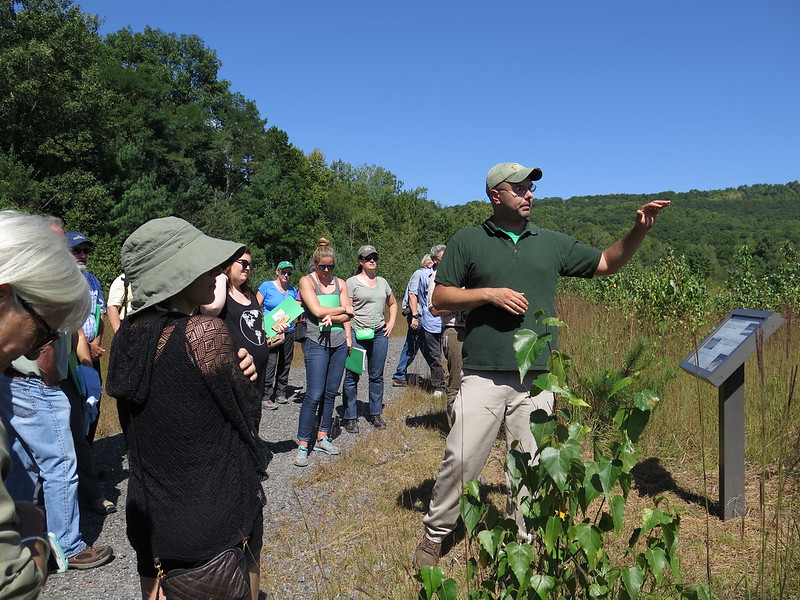
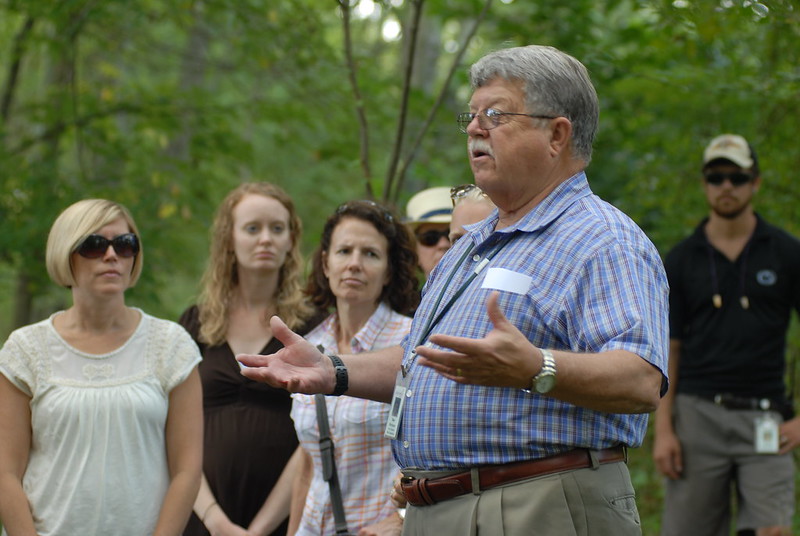
Keynote speaker Andrew Pitz took the truly global issue of climate change and, with an hour-long presentation based loosely on training provided by former Vice President Al Gore's organization, made it truly local, ending with a call for local action.

Being located on a section of the earth, there is no way for Southeast Pennsylvania to avoid the effects of planet-wide climate change and we had better start preparing for the effects if we want to adapt, survive and thrive, he said.

Consider, he said, that with no change in the amount of carbon we pump annually into the atmosphere, the number of days over 90 degrees in Southeastern Pennsylvania will rise from the current number of between 10 to 40 per year to 50 to 90 days per year by 2040.

"Not the kind of weather I'm looking forward to," said Pitz who, when he is not giving climate presentations, is the vice president of strategic policy and planning for the Natural Lands Trust.

Pitz is up front about telling his audience that he is not a scientist, but "a scientifically literate layman."

And there's little doubt he's done his homework.

He begins, for example, in the beginning — well, 63 million years ago at least, when the level of carbon dioxide in the atmosphere was 1,000 parts per million and the earth was free of ice.

Flash forward 43 million years and the CO2 concentration has dropped to 400 parts per million and the surface of Greenland, currently the earth's largest glacier, remains covered with forest.

Throughout the planet's long history, temperatures have swung wildly from one extreme to the other until the magic moment — about 100,000 years ago.

That's when the climate entered what Pitz calls the current "period of stability," during which, the concentration of CO2 began to hold steady; at least until the start of the industrial revolution, partially begun right here in the Schuylkill Watershed where the nearness of anthracite coal to a river that could transport it to a major city provided the right ingredients to change our way of life forever.

The period during which human civilization has sprouted and prospered has never experienced a climate with a CO2 concentration above 280 parts per million. The problem is the average concentration is now 285 parts per mission and will rise to 600 parts per million by mid-century "if we continue with business as usual," Pitz said.

More worrisome is "even if we stopped everything we were doing now," said Pitz, "temperatures would continue to rise — at least for awhile."

Already, greenhouse gas levels are escalating "considerably above the worst-case scenario that was projected just a short time ago," said Pitz.

Part of what's going on is a cascade effect.

Arctic ice acts like a mirror, Pitz said, directing 90 percent of sunlight back out into space.

As temperatures rise and ice melts — last summer one of three 4,500-year-old 40-meter thick ice sheets off Canada's Ellesmere Island broke free, floated into the sea and broke apart in just two weeks — that same sunlight hits open ocean. There 90 percent of the previously reflected sunlight is absorbed, hastening the warming.

More warming in turn allows the "permafrost" in the Arctic and Antarctic to thaw, releasing a huge amount of methane, which is a much more powerful greenhouse gas than CO2, which is currently trapped into the frozen soil.

As a film clip showed students setting ice on fire with just the methane being released from a hole dug in the permafrost, Pitz said its melting threatens to set off an "ecological landslide."

What does that mean for us?

Well for one thing, more rain.

In the 1900s, Pennsylvania averaged 38 inches of precipitation a year. Currently, we average 44 inches. Soon, we may see a 12-to-30 percent increase in that number, said Pitz.

And if it seems like we've been getting more extreme wind and thunderstorms lately, get used to it, because we have. Climate change has brought us more instances of winds of 60 miles per hour or higher between 1980 and 2007, Pitz said.

Also, despite the more intense rains, the number of days streamflow will be below the median threshold will likely double from 60 to 120; snowpack that now lasts for 30 days will all but disappear from Pennsylvania and we will see 10 to 20 droughts in a 30-year period in the Schuylkill Watershed if we don't change our lifestyle, said Pitz.

Solutions range from what some might see as extreme, to more moderate.

Pitz said NASA climatologist James Hansen has argued we must stop burning coal altogether in the next 20 years, although oil and natural gas can still be burned, if we are to have any chance of stopping or reversing current temperature trends.

The alternative, according to Hansen, is "irreversible catastrophic effects," said Pitz.

It is possible, or, some might argue, unavoidable "to get depressed thinking about this stuff," Pitz confessed.

But there are things to be done in our own backyards to mitigate the effects of warming, we must simply choose to do them, Pitz said.

For example, conservation, said Fritz, will play a critical role because of an increase in forests and soils that can absorb and sequester carbon.

The need to respond to the crisis is also driving science in new directions and encouraging more interaction and cross-pollination between disciplines, he said.

"There was always a lot of good work going on, but it was always with tunnel vision. But we have to start getting the thinkers and the doers in the same room as much as possible," he said.

Writer Alice Walker said it best, Pitz said, when she said "we live in the best of all times."

Walker, he said, told us what is necessary:

"There's no shortage of work to do. There's no excuse for anyone, in my opinion, to complain that they can't change anything. For instance, there are millions and millions and millions of hungry children, people who don't have clothing, people who don't have housing, trees that are begging us to let them live, rivers that are crying out to be clean, skies that are shouting at us to let the ozone layer live. There is no end to the ways we can have full self-realization. That's what has to happen, and that's what this time is pointing out. This is the time to have full self-realization as an earthling. It's time to be responsible and take charge of that. It's also a great time because if we fail, we lose the earth."

http://www.pottstownmercury.com/articles/2009/03/09/news/srv0000004855909.txt